Diana lapja

A Meditáció

„A meditáció a belső dimenziók felfedezésének hasznos és gyümölcsöző módszere, mely szisztematikusan, minden szinten az élet mélyére hatol.” (Swámi Rama, 2007)
A meditáció az elme elcsendesedése, s így a gondolatok mögé kerülés. Átéljünk a lelkünkkel való kapcsolatot, érzékeljük a belső lényünk finomanyagi, árnyalt energetikus rezgéseit.
Mivel minden ember lelke más és más, így az út a lelkünkhöz is különböző. A meditációs gyakorlatok közül az, amelyik az egyik embernél működik, a másiknak talán nem nyújt semmit. Egy hegyet is ezer féle módon megmászhatunk, de az utat (gyakran szoktuk ezt ösvényként is említeni) mi magunk választjuk meg. A legnagyobb tanítók épp ezért nem erőltetnek adott meditációs technikát a gyakorlónak, hiszen a gyakorló lelke rá fog rezonálni majd a saját meditációs technikájára, a saját belső bölcsességére, mely egybekapcsolódhat a közös kollektív bölcsességgel. Végső soron elér(het) egy non-duális állapotot, a nirvánát, mely pl. túlhalad minden ítélkezést, minden jó és rossz koncepciót.

A  meditációról beszélni olyan mintha egy szelet csokoládétortáról beszélnénk, melyet nem kóstolnánk meg, s nem lenne ezáltal szubjektív tapasztalatunk róla. Ekkor megmarad bennünk például a vágy és a kíváncsiság.
Az igazi meditációt nem lehet szavakkal körülhatárolni, leírni. A puszta elmélkedés, filozofálás a végső valóságról nem vezet el a végső valóság megtapasztalásához. mint ahogy például a hintázásról való elmélkedés sem vezet el a hintázás megtapasztalásához. Ugyanakkor jó tudnunk létezik hinta, s azt is, hogy mire szolgál a hinta. Hogyan szálljunk bele a hintába, hogyan lendítsük magunkat, s milyen magasságokat érhetünk el a hintázás során, s egyáltalán milyen hinták léteznek a világon.
Az elmélet és a gyakorlat összefügg, egymást támogatják. A tan iránymutató a meditálónak, a gyakorlat pedig ahol az, ahol élmény manifesztálódik.
A meditáció tehát a gyakorlatban tapasztalható meg.  S  kinek milyen tapasztalásai lehetnek? Érdekes módon ez egyedi, mégis vannak általános jellegzetességek is. Erről egy másik posztban szeretnék írni a téma tágassága miatt.
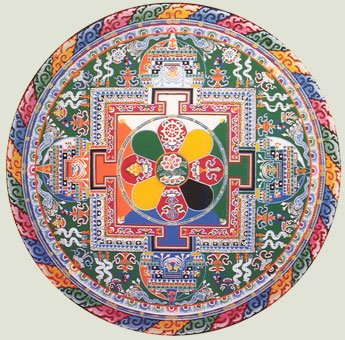

Homokmandala

A homokmandala a tibeti buddhista hagyományban színes homokból készített, majd szertartásosan lerombolt mandala. mandalaA homokmandala szimbolikusan kifejezi azt a buddhista nézőpontot, hogy a valóságban az anyagi dolgok átmenetinek tekinthetők, semmi sem állandó . A homokmandalákban szereplő ábrák és színek is meghatározott jelentéssel bírnak, amelyet gondos aprólékossággal készítenek el az alaposan felkészített buddhista szerzetesek.A homokmandala gyakran a békét, harmóniát reprezentálja, akár a nézése is megváltoztathatja a gondolkozásunkat a buddha tudat lenyomatát keltve bennünk.
A videoban a homokmandala elkészítését, majd lerombolását látjuk: 

 A mandalák leginkább egy háromdimenziós mennyei palota két dimenziós leképezései, amelyek segítik a meditálót a gyakorlásban. A buddhista kozmológiában a kép minden részének egyedi szimbolikus értelme van. A külső körök jelentik a palota falait, amelyek elválasztják a belső, szent földet a külső káosztól. A körök kívülről befelé a Tűz-hegy ötszínű lángköre, amely a nemtudás elégetésére képes bölcsességet jelképezi. A vékony vadzsrasor (tibeti: rdo rje ra ba) arany gyémántjogarokból áll, amely a megvilágosodást jelenti. Belül húzódik a bölcsességet és tisztaságot kifejező Lótuszszirom-kör (tibeti: pad ’khor). Ez Avalókitésvarát jelképezi. A magasabb tantrikus osztályok mandaláinál szerepelhet még a Nyolc Temető (tib.: dur khrod brgyad) köre is. A palota kettős vadzsrán nyugszik egy parkszerű térben, amelynek díszes kapui a négy égtáj felé néznek. A többi résszel ellentétben a kapukat nem felülnézetből látjuk, hanem oldalnézetből. A palota falát a szellemi tanítás különböző részeit jelképező szimbólumok ékesítik, pl. füzérek, drágakövek, vázák, és győzelmi zászlók. A palota belső kertjében meditáló mesterek azt jelképezik, hogy azok mindig segítik tanítványaik útját. A palota közepén található a mandala ura, konkrét ábrázolásban vagy az őt jelképező valamilyen tulajdonsággal vagy szent szótaggal. A gyakorló célja, hogy eljusson a középpontig és azonosuljon az adott istenséggel.

A kálacsakra mandala például 722 istenséget ábrázol összetett geometriai formák rendszerén belül. Más, kisebb mandalákban, mint például a Vadzsrabhairavaistenségnek szánt mandala, sokkal kevesebb istenség szerepel, ezért kevesebb mértani szerkesztést igényel, de még így is több napig készül. Ahogy minden mandala, a homokmandala is a háromdimenziós környezet kétdimenziós megjelenítése. Két közismert mandala három dimenziósan készült: a jávai Borobudur és akambodzsai Angkorvat.

text: https://hu.wikipedia.org/wiki/Homokmandala
picture: http://people.hws.edu/yignyen/mandalas.html
video: https://www.youtube.com/watch?v=10084L3Pqsc

Sand Mandalas

Of all the traditional Tibetan tantric practices, the art of painting with colored sand is one of the most unique and exquisite. In Tibetan language, this art is called dul-tson-kyil-khor, which literally means “mandala of colored powders.”

Millions of grains of sand are painstakingly laid into place on a flat platform over a period of days or weeks before ultimately being dismantled in order to release and disseminate the deity’s blessings into the world to benefit all sentient beings.

Formed into traditionally prescribed Tibetan iconography that includes geometric shapes and a multitude of historical Buddhist spiritual symbols, the sand-painted mandala is used as a tool for consecrating, or blessing, the earth and its inhabitants, and provides for the practitioner a visual framework for establishing the enlightened mind of the Buddha.mandala

Pronounced mahn-DAH-la, meaning ‘house’ or ‘palace’, the mandala represents a Buddha’s divine place of residence. There are hundreds of mandalas representing each of the different tantric deities, each with its own unique set of details. To the practitioner, the mandala represents the activities and teachings of the particular deity represented in the mandala, and can be described as the residences of the respective deities and their retinues.

Whether made of sand, cloth, or metal, mandalas are used to aid in visualizing these dwellings. Sand mandalas are one of the most magnificent types of mandala construction and are associated with the most profound and elaborate Buddhist ceremonies in Tibet. Every color, dot, and line in the mandala represents an essential part of the deity and Buddhist philosophy. Each component must be placed in exactly the same place every time the mandala is constructed.

Although sand mandalas are made on a flat surface they are, to the devout, a three dimensional palace, representing the mind of the Buddha. The person contemplating the mandala enters into it, as they would a building or an enclosure.

The mandala construction itself is the result of long and disciplined effort, but it is nonetheless a temporary work. When the monks are finished, there is a dissolution ceremony where the deity is released by the dismantling of the mandala. The sand is cast into a body of water to emphasize and highlight the impermanence of all things and the importance of nonattachment. When the sand enters the water, the kindness and compassion of the deity are disseminated into the world to benefit all beings.

Mandalas are immensely complex symbolic structures, with many layers of meaning and beauty. Although very beautiful and aesthetically pleasing, mandalas are meant for religious use, and are not intended as museum works of art. It is only in recent years that the Dalai Lama has permitted mandalas to be made in public, as a means of teaching about Tibetan culture.

The teaching of the mandala is passed through an oral tradition started by Shakyamuni Buddha over 2500 years ago. It has been passed down over the ages and can be traced back through the lineages to the historical Buddha.

In its most basic form, Tibetan Buddhism can be broken down into two schools of study. First, the study of sutras is perfected; these are the teachings of Shakyamuni Buddha. The next phase of study is tantra, which was also taught by the Buddha to advanced practitioners. Tantra is the study of meditation on a deity, or Buddha, and is considered to be the swift path to enlightenment. Traditionally, a student of Buddhism is required to study the sutras before being allowed to study tantra. This still holds true for traditional monastic scholars in the Tibetan Buddhist tradition.

In 1988, His Holiness the 14th Dalai Lama, the spiritual leader of Tibetan Buddhism allowed the first construction of a mandala in the west to be open to the public. This mandala was the Kalachakra Mandala and was constructed in sand by the Namgyal Monks from Dharamsala India at the Natural History Museum in New York City. His Holiness opened up the viewing of the mandala as a cultural offering, and as a means to preserve Tibetan culture. His Holiness felt that it would be a benefit to the world, as it would enhance the lives of all living beings near the construction site.

A mandala is thought to bring peace and harmony to the area where it is being constructed. Simply viewing a mandala is believed by Buddhists to be enough to change one’s mind stream by creating a strong imprint of the beauty of perfection of the Buddha’s mind, as is represented in the mandala itself. As a result of this imprint, one may be able to find greater compassion, awareness, and a better sense of well-being.

His Holiness also wished to open this practice to the west as there was much confusion and misunderstanding concerning the purpose of the mandala. Since the construction of the first mandala in the west, many mandalas have been created all over the world. Many people are said to feel strong emotions upon viewing a mandala, regardless of the culture or part of the world they are from.

text: http://www.namgyal.org/sand-mandalas/more-about-mandalas/

picture: http://people.hws.edu/yignyen/mandalas.html
video: https://www.youtube.com/watch?v=10084L3Pqsc


Happiness

Have you seen this  video in which a cute  toddler is enjoying her very first rain experience?   🙂

Is happiness can be taught and learned?

According to Martin Seligman the answer is YES! 🙂  Seligman is credited as the father of Positive Psychology. He has a systematic theory about why happy people are happy, and he  uses the scientific method to explore it. Through the use of exhaustive questionnaires, Seligman found that the most satisfied, upbeat people were those who had discovered and exploited their unique combination of “signature strengths,” such as humanity, temperance and persistence.
Seligman’s conclusion is that happiness has three dimensions that can be cultivated: the Pleasant Life, the Good Life, and the Meaningful Life.

1,  The Pleasant Life is realised as the hedonist lifestyle where the  pleasure  is the primary or most important intrinsic article-0-0208F50F00000578-894_468x336good. We appreciate such basic pleasures as companionship, the natural environment and our bodily needs.
Express your heart. People who have one or more close friendships are happier. It doesn’t seem to matter if we have a large network of close relationships or not. What seems to make a difference is if and how often we cooperate in activities and share our personal feelings with a friend or relative.

Cultivate kindness. People who volunteer or simply care for others on a consistent basis seem to be happier and less depressed. Although “caring” can involve volunteering as part of an organized group or club, it can be as simple as reaching out to a colleague or classmate who looks lonely or is struggling with an issue.

 2, We can remain pleasantly “stuck” at this stage or we can go on to experience the Good Life. 
violinist-150x150  This can be achieved through optimal psychological state that people experience when      engaged in an activity that  is  appropritely challenging to one’s skill level, often resulting in immersion and concentrated focus on a task. 
This can result in deep learning and high levels of personal and work satisfaction. Csikszentmihályi calls this state as FLOW.  We can experience FLOW during several actions like running, dancing, writing an article….. about happiness.   

So keep moving, be active. Regular exercise has been associated with improved mental well-being and a lower incidence of depression. 

 3, The final stage is the Meaningful Life, in which we find our life and our days meaningful.  This stage usually appears  in religious practice and happiness. meditation-300x262Spirituality and prayer also provide people with an opportunity to engage in a meditative act. Meditation has been shown to have a strong link with well-being because it calms the body, reduces stress and anxiety, and also supports positive thinking. The cultivation of “sacred moments” in daily life, whether through journal-writing or daily spiritual exercises, has been associated with reduced levels of stress and an increase in psychological well-being. Finally, both spirituality and organized religion can help provide people with perspective, hope, and a deeper sense of meaning. By believing in something greater than themselves, it may help them stay positive in times of sadness, and foster resilience in its role as a coping strategy.

 Seligman’s theory is outstanding. It reconciles two conflicting views of human happiness:
 the individualistic approach (1) , which emphasises that we should take care of ourselves and develope our own strengths and  the altruistic approach (2), which tends to downplay individuality and emphasizes sacrifice for the greater purpose.


Ahimsa

Let me  share a personal story with you. Last year I was on a Reiki practice , and during the practice I saw a beautiful symbol in my hand radiating to my palm. After getting home I was searching for the pic on the internet, and it turned out to be the AHIMSA symbol. reiki ahimsa
I was interested in it. I felt I know it  from the collective consciousness and from my “cells in my body”.

 Ahinsa (Sanskrit: अहिंसा;  Pali: avihiṃsā) is a term meaning ‘not to injure’ and ‘to be compassionate’. The word is derived from the Sanskrit root hiṃs – to strike; hiṃsā is injury or harm, a-hiṃsā is the opposite of this, i.e. cause no injury, do no harm.Ahinsa is also referred to as nonviolence. and it applies to all living beings – including all animals – according to many Indian religions. Ahinsa is one of the cardinal virtues and an important tenet of 3 major religions (Jainism, Hinduism, Buddhism).
 Ahinsa is a multidimensional concept, inspired by the premise that all living beings have the spark of the divine spiritual energy; therefore, to hurt another being is to hurt oneself. Ahinsa has also been related to the notion that any violence has karmic consequences. While ancient scholars of Hinduism pioneered and over time perfected the principles of Ahinsa, the concept reached an extraordinary status in the ethical philosophy of Jainism. Most popularly, Mahatma Gandhi  strongly believed in the principle of ahinsa.

Ahinsa’s precept of ’cause no injury’ includes one’s deeds, words, and thoughts.Classical literature of Hinduism such as Mahabharata and Ramayana, as well as modern scholars debate principles of Ahinsa when one is faced with war and situations requiring self-defense. 

Ancient texts use ahinsa to mean non-injury, a broader concept than non-violence. Non-injury implies not killing others, as well as not hurting others mentally or verbally; it includes avoiding all violent means – including physical violence – anything that injures others. In classical Sanskrit literature of Hinduism, another word Adrohi is sometimes used instead of Ahinsa, as one of the cardinal virtues necessary for moral life

Hinduism

Ancient Vedic Texts

Ahinsa as an ethical concept evolved in Vedic texts.The oldest scripts, along with discussing ritual animal sacrifices, indirectly mention Ahinsa, but do not emphasize it. Over time, the Hindu scripts revise ritual practices and the concept of Ahinsa is increasingly refined and emphasized, ultimately Ahinsa becomes the concept that describes the highest virtue by the late Vedic era (about 500 BC). For example, hymn 10.22.13 in the Rig Veda uses the words Satya (truthfulness) and Ahinsa in a prayer to deity Indra; later, the Yajur Veda dated to be between 1000 BC and 600 BC, states, “may all beings look at me with a friendly eye, may I do likewise, and may we look at each other with the eyes of a friend”.

The Epics

The Mahabharata, one of the epics of Hinduism, has multiple mentions of the phrase Ahinsa Paramo Dharma (अहिंसा परमॊ धर्मः), which literally means: non-violence is the highest moral virtue. For example:

अहिंसा परमॊ धर्मस तथाहिंसा परॊ दमः।
अहिंसा परमं दानम अहिंसा परमस तपः।
अहिंसा परमॊ यज्ञस तथाहिस्मा परं बलम।
अहिंसा परमं मित्रम अहिंसा परमं सुखम।
अहिंसा परमं सत्यम अहिंसा परमं शरुतम॥

The above passage from Mahabharata emphasizes the cardinal importance of Ahinsa in Hinduism, and literally means: Ahinsa is the highest virtue, Ahinsa is the highest self-control, Ahinsa is the greatest gift, Ahinsa is the best suffering, Ahinsa is the highest sacrifice, Ahinsa is the finest strength, Ahinsa is the greatest friend, Ahinsa is the greatest happiness, Ahinsa is the highest truth, and Ahinsa is the greatest teaching.


Modern times


Gandhi promoted the principle of Ahinsa very successfully by applying it to all spheres of life, particularly to politics.

 In Gandhi’s thought, Ahinsa precludes not only the act of inflicting a physical injury, but also mental states like evil thoughts and hatred, unkind behavior such as harsh words, dishonesty and lying, all of which he saw as manifestations of violence incompatible with Ahinsa. Gandhi believed Ahinsa to be a creative energy force, encompassing all interactions leading one’s self to find satya, “Divine Truth”. 

The hand with a wheel on the palm symbolizes the Jain Vow of Ahinsa. The word in the middle is “Ahinsa”. The wheel represents the dharmacakra which stands for the resolve to halt the cycle of reincarnation through relentless pursuit of truth and non-violence.


Szepes Mária – A segítésről


Szepes Mária 

Író, forgatókönyvíró, költő, színész


Interjú Máriával :

“Én csak kiszolgáló vagyok, és boldog vagyok, hogy az lehetek.

Mindig a másikról van szó, arról, hogyan tudja magát fölemelni, és átfogni

a világmindenséget egészen addig a végig, ami nincsen.

Örökkévaló van, Isten van, Krisztus van, csak én nem vagyok.

Én csak szolgálok  végtelen örök. Ezért vagyok itt.”….

” nem gondolok soha magamra se, csak arra akin segíteni akarok , és ……sikerül.”

-Mindenkinek sikerülhet ilyen állapotba eljutni?

– „ha olyan állapotba van, hogy befogadja, IGEN.

-de hogyan kerülhetünk olyan állapotba , hogy nyitottá váljunk?

-így , ahogy most fogod  kezemet, így ahogy mellettem vagy.

Így , ahogy szeretsz. Így ahogy szeretlek. S magamra nem gondolok.

Kis szolgálója vagyok a végtelen Istennek, és Krisztusnak.

-valójában ilyen egyszerű az egész ?

egész egyszerű…és a világ legnehezebb dolga. Mert az emberek

elzárkóznak a nagytól, és a kicsibe menekülnek.

Futnak, futnak meg nem állnak…amíg a középponton el nem találják azt az időt,

azt az állapotot, amikor nagyra tágulnak és befogadják az egészet.

-ezek szerint az egészről beszélsz,…nincsenek is külön vallások?

-nincsenek külön vallások..csak mindenkié a sajátja, de úgyhogy csak szeret és

nem gyűlöl senkit és semmit és örökké töltekezik és  sosem telik be. Mert ez örök  :  ez Ő.

-bennünk van a végtelen?

-Bennünk van a végtelen , hogyne..csak ne gondoljunk az Én-re, hanem a mindenre.

Fogadjuk be, amennyit befogadunk az a miénk.

-Tehát minél többet adunk, annál  gazdagabbá válunk?

-Hihetetlenül gazdaggá válunk. De nem gondolunk a gazdagságra,

hanem arra hogy szolgálói vagyunk egy hatalomnak, amely fölmérhetetlen.

Nyitottak vagyunk széttárt karokkal,széttárt szívvel és érzékekkel és

telünk telünk telünk..a mindenséggel.

– De hát Mária, félünk szeretni… félünk szeretni, mert aki szeret az  kiszolgáltatott.

-Azt kell legyőzni, a félelmet…és átváltani arra, hogy mi kis cselédei vagyunk Istennek, 

a láthatatlan hatalomnak…és őt szolgáljuk. Mi nem vagyunk, mi szolgálók vagyunk.

Ez a dolgunk…adni és segíteni…ez a dolgunk.

-Ne haragudj, hogy ezt mondom, de te is csak egy ember vagy és téged is bántottak.

Hiszen amikor a Vörös Oroszlánt megírtad..

-Akkor bántanak amikor van miért..Óriási hatalmas munkát végez ez a kicsi kis történet,

átfogja a világmindenséget és fényt gyújt ott is ahol sötét van, mindenütt.

-Te hogy élted meg emberként azt, hogy bántanak? Hiszen te adni akarsz, szeretni akarsz.

-Nehezen. De a nehéz a könnyű.

-A nehéz a könnyű?

-Igen, a nehéz a könnyű, magamra nem gondolok. Csak rá, akin segíteni kell…és

Istenre aki örökkévaló.

-Te azért születtél, azért vagy, hogy segíts.  Most, nem titok …99 éves vagy….a 9 az az Úr száma……

-igen, s a 9 a remete száma…

-te egyre többet meditálsz ugye?

-már úgy születtem az anyámba,már ott gyűjtögettem azt, amit hozni fogok…

ebbe a szerencsétlen világba…ahol olyan kevés a jó, és olyan rengeteg a rossz.

Segíteni, mindig segíteni..alázatos kis cselédként szolgálni…

-Mária egy olyan embernek, aki még soha sem tette, hogy lehet megtanulni meditálni?

-Nem kell tanulni, meg kell nyílni neki , s jön és ömlik belé, zúdul belé. ..


~DHAMMAPADA~ verses: 33-36 ~ Hungarian-English-Pali ~

k20_950x304t2_ic 
AZ ELME
citta vagga
33-36 
 
 A nyílkészítő sima nyílvesszőket készít;
a bölcs is kisimítja remegve vibráló, ingatag elméjét,
melyet oly nehéz szilárdan tartva irányítani.
Miként a hal, melyet kiragadtak.  
 
vízi otthonából és a szárazföldre dobtak,
éppúgy ficánkol kétségbeesve az elme,
hogy kiszabaduljon a Kísértő uralmából. 
 
A nehezen megfékezhető, 
csapongó, vágyűzött elmeellenőrzése jó.
A megfékezettelme boldogságot hordoz. 
 
A csapongó, vágyűzött elmét
a bölcs irányítsa arra, ami mélyen rejtett,
amit oly nehéz meglátni. 
A jófelé irányított elme boldogságot hordoz
 

3. chitta-vagga — Thoughts

phandanaM chapalaM chittaM duurakkhaM dunnivaarayaM
ujuM karoti medhaavii usu-kaaro va tejanaM. 33

Elusive and unreliable as it is, the wise man straightens out his restless, agitated mind, like a fletcher crafting an arrow. 33
33. The discerning man straightens his mind, which is fickle and unsteady, difficult to guard and restrain, as the skilled fletcher straightens the shaft (of the arrow). 33.

vaarijo va thale khitto okam-okata-ubhato
pariphandat’ idaM chittaM maara-dheyyaM pahaatave. 34

Trying to break out of Mara’s control, one’s mind writhes to and fro, like a fish pulled from its watery home onto dry ground. 34
34. As the fish, taken out of its watery home and thrown on land, thrashes around, so does the mind tremble, while freeing itself from the dominion of Mara (the Evil One). 34.

dunniggahassa lahuno yattha-kaama-nipaatino
chittassa damatho saadhu chittaM dantaM sukh’aavahaM. 35

It is good to restrain one’s mind, uncontrollable, fast moving, and following its own desires as it is. A disciplined mind leads to happiness. 35
35. The mind is unstable and flighty. It wanders wherever it desires. Therefore it is good to control the mind. A disciplined mind brings happiness. 35.

sududdasaM sunipuNaM yattha-kaama-nipaatinaM
chittaM rakkhetha medhaavii chittaM guttaM sukh’aavahaM. 36

A wise man should guard his mind for it is very hard to keep track of, extremely subtle, and follows its own desires. A guarded mind brings happiness. 36
36. The mind is incomprehensible and exceedingly subtle. It wanders wherever it desires. Therefore, let the wise aspirant watch over the mind. A well-guarded mind brings happiness.


~DHAMMAPADA~ verses: 5-8 ~ Hungarian-English-Pali ~

20130508-hir-bionaturmagazin-kezek


 Verses 5-8:

~ Hungarian ~

 ~ English ~

 5  

A gyűlölet sohasem szünteti meg a gyűlöletet, 

csak a szeretet. –

Ez az örökkévaló Törvény.

Hostilities aren’t stilled through hostility,

regardless.

Hostilities are stilled through non-hostility:

this, an unending truth.

 6  

Sokan nincsenek tudatában annak, 

hogy egyszer mindenki meghal.

Akik ráébrednek erre,

azonnal abbahagyják az ellenségeskedést.

Unlike those who don’t realize that

we’re here on the verge of perishing,

those who do:

their quarrels are stilled.

 7  

Ha az élvezeteknek él, nem ellenőrzi az értékeit,

mértéktelen  az evésben , lusta és erőtlen,

akkor a KÍsértő biztosan legyőzi,

ahogy a szél is ledönti a gyenge fát.

One who stays focused on the beautiful,
is unrestrained with the senses,
knowing no moderation in food,
apathetic, unenergetic:
Mara overcomes him
as the wind, a weak tree.
 8  

Ha nem az élvezeteknek él, ellenőrzi az értékeit,

mértékletes az evésben , erős és hite szilárd,

akkor  a Kísértő éppúgy nem fogja legyőzni,

ahogyan a szél sem dönti le a kősziklát.

One who stays focused on the foul,

is restrained with regard to the senses,

knowing moderation in food, full of conviction & energy:

Mara does not overcome him as the wind, a mountain of rock.


~ Pali original text –  verses 5-8 ~

5
na hi verena veraani sammant’iidha kudaachanaM
averena cha sammanti esa dhammo sanantano.
6
pare cha na vijaananti mayaM ettha yamaamase
ye cha tattha vijaananti tato sammanti medhagaa
7
subh’aanupassiM viharantaM indriyesu asaMvutaM
bhojanamhi ch’aamattaññuM kusiitaM hiina-viiriyaM
taM ve pasahati maaro vaato rukkhaM va dubbalaM
8
subh’aanupassiM viharantaM indriyesu susaMvutaM
bhojanamhi cha mattaññuM saddhaM aaraddha-viiriyaM
taM ve na’ppasahati maaro vaato selaM va pabbataM


Tonglen technika

A tibeti Tonglen technika,  egy mély tisztánlátást generáló gyakorlat, amit mind a hétköznapokban, mind terápiaként is tudunk használni. Megfelelő gyakorlással a lelki segítségnyújtás egyik leghatékonyabb, mégis szótlan formáját kapjuk kezünkbe.

Technikája – Az alapséma, s az én tapasztalataim alapján: 

-Meditációban képzeld el vagy vizualizálj  valakit, akit ismersz és szeretsz , és aki iránt együttérzés gyúlt benned, mert  nagyon szenved, pl. betegségtől valakinek az elvesztésétől, depressziótól, fájdalomtól, szorongástól, félelemtől.
Csukott szemmel ülsz, lassan egymás után ellazítod a testrészeidet, a talpadtól haladva felfelé ….a bokádat, az alsó lábszáraidat, a combokat, az alhasadat,  az ülőgumokat, a gyomrod tájékát…..most a szívteredet, …..a torokcsakra területét .
Végigmész a gerinceden, ….a vállaidon…fel egészen  a hajas fejbőrig, lazítsd el most az arcizmaidat, s kisimulnak az arc izmai,  megpihen a tudatod a szemgolyók mögött. 
Szánj időt a folyamatra.

Légy ebben a relaxált állapotban, tisztán, egyszerűen. 
Lélegezz …. légzésed legyen egyszerű,  normális. Ha hosszú akkor hosszú, ha rövid akkor rövid. 

Hozd a tudatosságodba az illetőt aki szenved, s akinek óhajtod a szenvedéstől való megmenekülést, s a felszabadult boldogságot. 
Ha ő egy kisgyermek…   mit teszel ha sírni látod? Odamész, s átöleled  együttérzésed “takarójával”. Lágyan, és éppen olyan ” jelenléttel”, hogy érezze, megtartod ebben a helyzetben, amiben most van.

Együttérzésed felé olyan mély, hogy a szívtered akár egybeér az övével. “Pusztán” szereted őt. Engeded áramolni az univerzumi bölcsességet, szeretetet…..legyen  az, ami Isteni tudatosságú, legyen aminek lennie kell.  Legyen ami neki a “legjobb”.
Bebugyolálod   a szeretet fényburkával, mely éppen annyira fénylik – az egyén számára felfogható láthatóságban- ami számára megfelelő.  Ezt nem te döntöd el,milyen legyen számára a jelenléted erőssége, s a fény erőssége, hanem az egyén lelke, s az univerzumi tudatosság.

Gyógyítasz.Őt,  magad, s az összes embert akinek hasonló a szenvedése. Hogyan ..?

Belélegzéskor képzeld el, hogy az adott személy összes szenvedése – sötét, fekete, füstszerű, szurkos , vastag és súlyos felhőzet formájában – beáramlik az orrlyukadon , a garaton , nyelőcsövön át…telíti a mellkasad…benne a  szívtered.  

Vajon hogyan állsz a másik ember szenvedésével?

A szívtér egészen különleges, hiszen itt érezzük  a fájdalmat, a szomorúságot, a szeretet, illetve a  boldogságot. 
Meg tudod -e engedni magadnak, hogy  benn tartod a szívteredben az illető  szenvedését? 

Lehetséges, hogy más érzések is megjelennek benned, más testterületekről..düh, félelem, fájdalom. 

Sokak számára ez félelmetes, hisz azzal hogy szembesülsz a másik szenvedésével, önmagad ezen érzései felé is tudatosságra ébredsz. S nemcsak önmagad , hanem az összes ember hasonló szenvedéssel teli érzéseire.

Kilégzéskor a gyűjtsd össze minden békességedet, szabadságodat, egészségedet, jóságodat és erényedet…..és küldd az adott személy felé gyógyító , felszabadító fény formájában. Kérd rá az Isteni áldást, az univerzumi szeretettel és bölcsességgel teli  enyhülést 

Képzeld magad elé, hogy az egészet magába fogadja és tökéletesen szabaddá, oldottá és boldoggá válik.

Ismételd ezt meg néhány lélegzetvétellel.
-Majd képzeld magad elé a várost , ahol ez a személy él, és belélegzéskor fogadd magadba a város összes szenvedését, és küldd helyébe a saját egészséged és boldogságod az ott lakóknak.
Azután tedd ezt meg az egész államért,  országért, bolygóért, világegyetemért.
(HA úgy érzed te magad vagy a világegyetem -ritka eset -akkor ez már egybe is ér.)
-Befogadod az összes emberi lény szenvedését , és boldogságot, erényt küldesz helyette.

-Lesz e bajom ettől a gyakorlattól?
A tonglent azért fejlesztették ki, hogy lenyesegessük magunkról egoista öntömjénezésünket, önvédelmi mechanizmusainkat. Ez a gyakorlat felcseréli az ént a másikkal, így mélyen aláássa az alany-tárgy kettősséget, egyetlen én létezik, nem elkülönültek vagyunk, valamint növeli együttérzésünket is, képesek vagyunk behelyettesíteni az ént a “másikkal”.
Azt kéri tőlünk, hogy épp ott ugorjunk a “vízbe”, ahol mi is “megsérülhetünk”.
Ha valaki gyakorolja a tonglent , nem betegszik meg inkább nem riadsz vissza szembenézni mások fájdalamival, szenvedéseivel, nem hárítasz,, nem játszmázol, nem beszélsz ki csak jelen vagy… segítőleg, együttérzőn.. míg a jelenlét szükséges. befogadás-elengedés.

-Ilyenkor az én örül minden sikernek, örvend mások erényeinek (hisz ebben a tudatosságban egyek vagyunk) , nem kettős éber tudatosság van. Csodálatos egyenlőség-tudat van, mely aláássa az önhittséget, a büszkeséget, a félelmet, irigységet.
Bíztatlak, tegyél magadért, s embertársaidért.

A tonglen technika ezen leírása folyamatos fejlesztés(em) alatt van.


5 tibeti jógagyakorlat

Napi 15 perces tornával, rendkívül jó egészségmegőrző programunk lehet. HA nincs időd , vagy kedved  minden nap 10-20 km-es túrákhoz, de mégis tennél önmagad és a családod egészségéért. Gyermekkel együtt  is jó móka. Lássuk a pozitív hatásokat:

  • múlik a depresszió
  • javul a közérzet
  • nincs állandó fáradtság
  • eltűnnek az ízületi fájdalmak
  • megszűnnek a légzőrendszeri problémák
  • javul a pajzsmirigy működése
  • még az ősz haj is visszasötétedik
  • észrevétlenül lefogyunk
  • szép izomzat alakul ki
  • megszűnik a narancsbőr
  • kisimulnak a ráncok

Röviden a kulcs a csakrák harmonizálása. A lelassult vagy megállt energiakerekeket indítja be újra a tibeti szerzetesek jógája,  így történhet az, hogy amiről nem is tudtuk, hogy elromlott, az is megjavul és működni kezd újra.
Sok szerencsét, örömteli perceket a kipróbálásában. 🙂

Mobil nézetre váltás Teljes nézetre váltás
Üdvözlünk a Cafeblogon! Belépés Regisztráció Tovább az nlc-re!